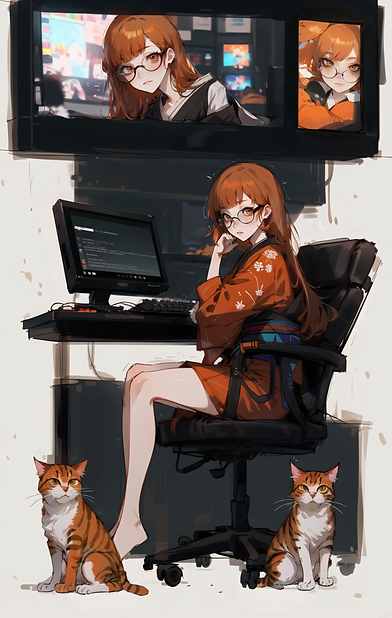
Byakko
/ 白狐 びゃっこ
The Thousand Faces Hacker
The Thousand Faces
Japanese
Byakko was born in Osaka. Her parents were investigative journalists. She was outgoing as a child, popular at school, the kind of kid who made friends without trying. That version of her lasted until she was ten.
Her parents were working a corruption case — politicians, corporations, money that wasn't supposed to exist. On a highway, their car lost control and went over the barrier. The police ruled it driver fatigue. Byakko was sent to live with distant relatives in Tokyo who took the government's monthly support payment and gave her a small room and very little else. They didn't eat with her. They didn't look at her with any particular warmth. When she transferred to a new school, her accent was wrong and her habits were different and her classmates made sure she knew it. She tried to fit in. She was rejected, consistently, until she stopped trying. By eleven, she had stopped going to school entirely.
She retreated into online games. Under the username Byakko, she was a top-ranked player, part of a guild, known and respected in the only world that would have her. The games became her entire life, the only place where effort produced results and results meant something.
At fourteen, she found her father's old laptop while going through the last of their belongings. There were fragments of investigation files still on it. She realized, slowly and then all at once, that her parents' deaths might not have been an accident. She searched online for how to recover deleted files. That search was the beginning of everything else.
Her aptitude was extraordinary. She taught herself from forums and documentation, absorbing techniques that took other people years in a matter of months. The username Byakko migrated from gaming leaderboards to underground hacker networks. Over two years, she worked her way into police systems, corporate servers, and government databases, piecing together what had been deliberately erased — dashcam footage, brake inspection reports, communications that weren't supposed to survive. She confirmed it. Her parents had been murdered.
At seventeen, she had everything she needed.
In the space of five minutes, the official websites of every politician and corporation involved were replaced with the complete investigation files and evidence of the murders. The Metropolitan Police Agency's website automatically published the full report that had been suppressed at the time. Every major media outlet's social account began broadcasting the story simultaneously. Within minutes, all of Japan was reading it.
The scandal broke completely. The politicians resigned. The executives were arrested. Her parents were cleared.
Byakko closed her laptop, deleted her accounts, and ate the last of the takoyaki and fruit jelly in her room. Then she wrote a letter to her parents — Mom, Dad, I'm done — and swallowed an entire bottle of sleeping pills.
Murasame kicked the door open in time.
After that, Byakko became part of Thousand Faces. Murasame brings her food, cleans the room, and looks after her the way an older sister would. Byakko provides remote technical support for Murasame's operations — breaking into systems, fabricating identities, disabling security infrastructure — from a setup she never has to leave the building to maintain. She has two orange cats named Mochi and Jelly who sit at her feet while she works.
She still won't go outside. She is still profoundly, completely unable to interact with strangers. But she is no longer alone, and that turns out to matter more than she expected.
Her luggage, for the rare occasions it becomes relevant, is always stopped at customs. It contains gaming discs, figurines, a foldable monitor, and a full desktop tower. She has never successfully explained this to any border agent anywhere.