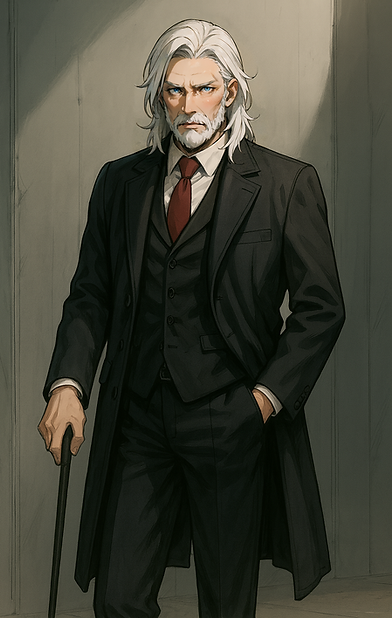
Albert Winston Halloway
Founder and Current Director of the GIA / Omega-Level Operative
GIA
British
Albert was born in 1898 in a Wessex slum. His father was a miner who drank. When the man died of a heart attack, Albert was fourteen and immediately responsible for his mother and younger sister. He found work on the docks.
In 1914, the war started. Albert was sixteen and lied about his age to enlist, because the army offered food and a wage. He was assigned to the Somerset Light Infantry and shipped to France.
On July 1st, 1916, his unit was ordered to take a German fortification at the Somme. Two hundred men went forward. Twelve came back. Albert was one of them. He lay in a shell crater surrounded by the bodies of people he had known by name, and while the artillery continued overhead he saw something that he would spend years trying to decide was real — black shapes pulling themselves out of the dead, drifting across the battlefield without apparent purpose. He assumed he had lost his mind. He was not entirely wrong.
The Somme left him with severe PTSD and an opium dependency the British government had neither the budget nor the interest to address. He busked on London streets to keep his family fed.
In 1917, he met two people who changed everything: Catherine, and a young German idealist named Ludwig von Heranfinlo, a cousin of Kaiser Wilhelm II and a member of the Church's oldest bloodline. Ludwig recognized what Albert could do — absorb the dead, bind them to himself, call their shadows back into the world. He helped Albert off the opium. He brought him into the Church. Together they worked, and Albert learned the full shape of the world he had only glimpsed in the crater.
Ludwig was brilliant and principled and absolutely convinced that war was a problem reason could solve. Albert loved him the way you love someone who makes you believe things you wouldn't believe alone.
The war ended. Germany lost. The Versailles Treaty stripped the Heranfinlo family of most of their Church authority. Ludwig watched his country collapse into poverty and humiliation through the 1920s, and in 1933 he made the choice that Albert would spend the rest of his life trying to understand — he joined the Nazi Party. His letter said the Treaty had destroyed Germany and that he had no other way to save it.
During the Second World War, the Nazis established a secret research facility in Narvik, Norway, working with Lilith's remains in an attempt to engineer an immortal army. In 1945, with the war nearly over, Albert found Ludwig in the ruins of Narvik.
They faced each other across everything that had happened.
Ludwig had used his domain to contain an escaped subject and prevent it from reaching the outside world. He told Albert that someone had to end this — the experiment, the facility, the era it represented. He ordered Albert to shoot him. Albert couldn't do it. Then Ludwig detonated his own domain.
What came next Albert does not discuss in detail. He awoke to the full extent of his ability — the domain he calls the Other Shore, which lets him summon the shadows of the dead into battle. He defeated what remained of the experiment. Then he walked out of Narvik and kept walking, in no particular direction, for several months, until a Church retrieval team found him near the Arctic Circle. The idealist he had been was gone. What came back was a pragmatist with very long patience and very clear priorities.
In 1949, Churchill delivered the Iron Curtain speech and the Cold War began. The Church appointed Albert as a new elder, believing they were acquiring a useful instrument. He spent the next two decades proving them wrong. Using intelligence networks, financial leverage, and careful political infiltration, he methodically hollowed out the Church's operational authority. He founded the Global Intelligence Agency and its Academy. He converted the Inquisition into an intelligence service and the Crusaders into a special operations force. He enrolled demon-human hybrids as cadets. He used demons to fight demons.
By the 1970s, the Church existed in name and very little else.
Albert sits in his Academy office now, drinking Earl Grey because the opium is long behind him, working because sleep has never been something he fully trusted. The weight he carries is not only the dead — it is the memory of a young German idealist who believed the world could be reasoned with, and the knowledge of what that belief eventually cost.
He has not stopped believing it himself. He has simply learned to be more careful about it.